Internally Displaced Persons (IDPs) at the Kuchingoro camp in Abuja say they are apprehensive about returning to the northeast despite the orders by the government.
The Deputy Chairman of the camp, Mr Haliru Bello, said that news from their various villages indicate that it is not yet safe to return home.
Mr Bello was speaking at a Valentine’s Day celebration on Sunday in the camp in the Federal Capital Territory, with well-meaning Nigerians who came to show them love.
One of the donors at the IDPs camp, Bunmi Ademolu, spoke on the reason for the celebration and the need for everyone to help the government cushion the effect of the insurgency on the Nigerians.
The group of the goodhearted Nigerians who made out time to visit the IDPs, brought with them clothing, shoes, household essentials and monetary gifts.
While appreciating the gesture by the group, the displaced persons said that items brought by well-meaning Nigerians have sustained them throughout their ordeal.
Chicago rapper and songwriter Rhymefest, who has co-written with Kanye West over the years, tweeted that he stopped working with West last month and that the rapper needs counseling.
“My brother needs help, in the form of counseling. Spiritual & mental. He should step away from the public & yesmen & heal,” Rhymefest wrote in a series of tweets Friday (Feb. 12) to fans.
Rhymefest, whose real name is Che Smith, has helped West pen such songs as “Jesus Walks” and “New Slaves.”
Rhymefest went on to tweet that West’s “mind” and “spirit” aren’t right, but didn’t elaborate any further. “I love my brother. I pray for his health not our entertainment”
West is in the midst of releasing his latest album, Life of Pablo. The set was scheduled for release Friday, but got delayed becauseChance the Rapper was finishing vocals on the song “Waves.” West has been under fire for controversial lyrics about Taylor Swift.
Regularly dubbed ‘America’s fattest city’, Houstonites’ dietary choices are only one element of its spiralling diabetes problem. Can anything be done to reverse this deadly – and very costly – disease in a city addicted to sugar and cars?
Houston’s car-centric suburbs continue to expand along with its residents’ waistlines. Photograph: David R Frazier Photolibrary/AlamyDiabetes is so common in Patricia Graham’s neighbourhood that it has its own slang term. “At churches you run into people you ain’t seen in years, and they say, ‘I’ve got sugar,’” she says.
Graham does not quite have “sugar”, but when foot surgery in 2014 reduced her activity level, her blood sugar level soared. And there is a history of diabetes in her family: three of four brothers and her mother, who lost a leg to it.
So three times a week she comes to thesmart, modern Diabetes Awareness and Wellness Network (Dawn) centre in Houston’s third ward, a historically African American district near downtown. Used by about 520 people a month, Dawn is in effect a free, city-run gym and support group for diabetics and pre-diabetics: a one-stop shop for inspiration, information and perspiration. Last Friday Graham, 68, was there for a walking session.
Not that she or the half-dozen other participants went anywhere. This was walking on the spot to pulsating music. Had the class stepped outside they would have enjoyed perfect conditions for a stroll: a blue sky and a temperature of 21C. If they had worked up an appetite, a soul food restaurant was only a 15-minute walk away, serving celebrated (if not exactly sugar-free)food that belies its unpromising location in a standard shopping mall on a busy road next to a dialysis centre.
But most of Houston is not built for walking, even on a sunny January day. There’s the constant traffic belching fumes that linger in the humid air; the uneven sidewalks that have a pesky habit of vanishing halfway along the street; the sheer distances to cover in this elongated, ever-expanding metropolis. Walking can feel like a transgressive act against Houston’s car-centric culture of convenience – and its status as the capital of the north American oil and gas industry.
It’s one reason why Houston regularly finishes top, or close, in surveys that crown “America’s fattest city”. Unsurprisingly, it has a diabetes problem as outsized as its residents’ waistlines. By 2040, one in five Houstonians is predicted to have the disease.
According to data from pharmaceutical company Novo Nordisk, the prevalence of type 2 diabetes in the city is 9.1% – with an estimated one in four of these being undiagnosed. Almost a third of adult Houstonians self-describe as obese, according to a 2010-11 survey. Without action, the number of people with diabetes is projected to nearly treble by 2040 to 1.1 million people, with diabetes-related costs soaring from $4.1bn in 2015 to $11.4bn by 2040.
Graham is alarmed by the damage diabetes is wreaking on her community. “I was talking to my friends and saying, so many of the people we grew up with got diabetes and lost limbs,” she says. “It’s not even so much the seniors any more, it’s the young people. But it doesn’t scare them. They act like they’re not afraid.”
Another Dawn member, Verne Jenkins, was diagnosed three years ago. “I had picked up a bit of weight that I shouldn’t have,” says the 63-year-old. “I knew what to eat, I knew what I was doing, I just got out of control.”
Jenkins loves to bake but has cut back on carbs, red meat, salt and sugar, abstaining from one of her guilty pleasures, German chocolate cake. Not that it’s easy in a city with so much choice: “All these wonderful restaurants, all these different kinds of cuisines, of course you’re going to try some. I imagine it leads to our delinquency,” she says.
Graham has watched her diet since she was in her 20s. “I eat pretty good,” she said. “‘She eats like white folks’ – that’s what they tell me!”
Time poverty
Diabetes is a major cause of death, blindness, kidney disease and amputations in the US. While federal researchers announced last year that the rate of new diabetes cases dropped from 1.7 million in 2009 to 1.4 million in 2014, in Texas the percentage of diagnosed adults rose from 9.8% in 2009 to 11% in 2014.
Houston, America’s fourth-largest city, is one of five participating in the Cities Changing Diabetes programme, along with Mexico City, Copenhagen, Tianjin and Shanghai. Vancouver and Johannesburg are soon to join the project, which attempts to understand, publicise and combat the threat through cultural analysis.
“The majority of people with diabetes live in cities,” says Jakob Riis, an executive vice-president at Novo Nordisk, one of the lead partners in the programme alongside the Steno Diabetes Center and University College London. “We need to rethink cities so that they are healthier to live in … otherwise we’re not really addressing the root cause of the problem.”
One of the programme’s key – and perhaps surprising – findings, however, is that assessing the risk of developing diabetes is not as simple as dividing the population according to income and race. The problem is broad – much like Houston itself.
The prevalence of type 2 diabetes in Houston is 9.1%. Photograph: Philip Gould/Corbis
The view stretches for miles from Faith Foreman’s eighth-floor office next to the Astrodome, the famous old indoor baseball stadium. It’s an impressive sight, but for someone tasked with tackling the city’s diabetes epidemic, also a worrying one: the sheer scale of the urban sprawl is part of the problem. The threat of the disease has expanded along with the city.
Advertisement
A low cost of living and a strong jobs market helped Houston become one of the fastest growing urban areas in the US. In response, the city loosened its beltways. Its third major ring road is under construction, with a northwestern segment set to open soon that is some 35 miles from downtown.
Once completed, the Grand Parkway – whose northwestern segment has just opened – will boast a circumference of about 180 miles. That is far in excess of the 117 miles of the M25, although about 14 million people live inside the boundary of London’s orbital motorway, more than twice as many as reside in the Houston area.
Large homes sprout in the shadow of recently opened sections, promising cheap middle-class living with a heavy cost: a commute to central Houston of up to 90 minutes each way during rush hour, with minimal public transport options. “A lot of time in Houston is spent in a car,” says Foreman, assistant director of Houston’s Department of Health and Human Services. This informs one of the Cities Changing Diabetes study’s most notable findings: that “time poverty” is among the risk factors in Houston for developing type 2 diabetes.
This means that young, relatively well-off people can also be considered a vulnerable population segment, even though they might not fit the traditional profile of people who may develop type 2 diabetes – that is, aged over 45, with high blood pressure and a high BMI, and perhaps disadvantaged through poverty or a lack of health insurance.
“You generally think of marginalised, lower income communities in poverty as your keys to health disparities but I think what we learned from our data in Houston is that we now have to expand the definition of what vulnerable is and what at-risk means. Just because we live in an urban environment, we may all indeed be vulnerable,” says Foreman.
In other words, not only its residents’ dietary choices but the way Houston is constructed as a city appears to be contributing to its diabetes problem, so tackling the issue requires architects as well as doctors; more sidewalks as well as fewer steaks.
Pamphlets offered at supermarkets are part of campaigns to improve eating habits and reduce diabetes in Houston. Photograph: Pat Sullivan/AP
Urban isolation is a key challenge, says David Napier of UCL, the lead academic for Cities Changing Diabetes. “Houston is growing so quickly and also expanding geographically at such a rapid rate. When you look at how difficult it is for people just to get out and walk, or walk to work; the fact that so many people commute long distances, spend a lot of time eating out – they have a number of obstacles to overcome,” he says.
A city with notoriously lax planning regulations is now making a conscious effort to put more care into its built environment, with more public transport, expanded bike trails, better parks and denser, more walkable neighbourhoods all evident in recent years, even as the suburbs continue to swell.
Foreman’s agency has more input when officials gather to map out the future city. “That is something that has been a big change over the last two or three years in Houston,” she says. “We are at the table and we are working with city planning to make those decisions.”
But prevention is a vital focus as well as treatment. Along with his team, Stephen Linder of the University of Texas’ school of public health – the local academic lead for Houston’s Cities Changing Diabetes research – gathered data on 5,000 households in Harris County, which includes much of the Houston area.
“One way to approach this project wasn’t to focus on diabetes itself but rather to look at some of the preconditioned social factors that seemed to generate the patterns of living that then led to the clinical signs that would designate people as being prediabetic,” he says from his office at the Texas Medical Center near downtown Houston – the world’s largest medical complex.
“These were people who had neither disadvantage nor biological risk factors. They tended to be the youngest group and would normally escape any kind of assessment – we called them the ‘time-pressured-young’. They’re the ones who did the long commutes; they’re the ones whose perception was they could not manage their day’s worth of stuff, that they have no time for anything.”
For this group, obesity is so prevalent in Houston that it distorts an understanding of what a healthy weight is, Linder found. “Their perception of their health was affected by their peers as opposed to other sorts of references. If all of their peers were overweight then in a relative sense they were fine. The judgments were about one’s peers and not relative to any sort of expert standard,” he says.
Three neighbourhoods were identified as having the highest concentration of people vulnerable to developing diabetes, and a Dallas-area research company, 2M, conducted detailed interviews with 125 residents. One place was particularly surprising: Atascocita, a desirable middle-class area near a large lake and golf courses, about 30 miles north of downtown.
Houston is one of the fastest growing urban areas in the US. Photograph: UIG/Rex Shutterstock
Houston has become, according to a 2012 Rice University study, the most ethnically diverse large metropolitan area in the US. But this cosmopolitan air – one of the qualities sought by any place seeking to become a globally renowned city – may also unwittingly be contributing to the diabetes crisis, the study found.
Some in Atascocita, Linder said, “emphasised this sense of change and transition in their neighbourhoods, that that was a source of stress for them and that they were resistant to making changes in their own lives given the flux that was around them. Because that group happened to be older, even though they were economically secure they did have some other chronic diseases and they satisfied our biorisk characteristics.
“We call them concerned seniors. They weren’t making changes because there was too much else going on for them. And so if we were to say to them ‘you’ve got to change your diet’, they’d say ‘no, I can’t handle any more changes’.”
This matters since food portions are no exception to the “everything’s bigger in Texas” cliche, while Houston’s location near Mexico and the deep south, its embrace of the Lone Star state’s love of barbecued red meat and its enormous variety of restaurants serving international cuisine combine to unhealthy effect.
“The food that had a traditional aspect to it tended not to be the healthiest food – southern food that’s fried and lots of butter and lots of starch, then there’s African American soul food and then there’s Hispanic heavy fat, prepared tamales and the like, and so we found people kind of gravitated to what the UCL people called nourishing traditions,” Linder said.
“People used food as not only a reinforcement of tradition and ritual but also as a way of connecting socially. You’ve moved here from somewhere else, it’s a way to reinforce your identity, it’s a real cultural asset to have, but in a biological sense it’s not the best thing.”
For Linder, one lesson is that generalised advice about healthy eating that has long been part of diabetes awareness efforts may not be effective locally, given the complexity and variety of Houston’s neighbourhoods and the social factors that make populations vulnerable to diabetes.
“It does make the task of dietary change a much more complex one than the simple messages about changing your diet, eat more fruit and vegetables, get more colour on your plate would suggest. Those things bounce off, it’s not a useful set of interventions then for that particular group who rely on these nourishing traditions and find some solace in the change around them,” he said.
Foreman agrees that a targeted approach is vital. “How do you change diabetes in Houston? One neighbourhood at a time, in a sense, but at the same time you have bigger things that you can change systemwide in policies and how you work together collaboratively,” she said. “But then as you narrow it and get more granular it is neighbourhood, and what works in one neighbourhood may or may not work in another.”
Patricia Graham is hoping that the Dawn programme expands to other parts of the city to combat the dangerous union of unhealthy traditional food with a modern convenience culture. “Everything is food, and I mean lots of it and all the time,” she said. “Some people don’t know how to cook without grease or butter. That’s just the way we learn.”
PURPOSE OF LIVING "THE PURPOSE OF LIFE IS TO HAVE A LIFE OF PURPOSE" Robert Byrne. Purpose as pertains to life can be said to be very important and valuable to life. Purpose is attached to everything we do. It implies that our purpose of living is God-given and cannot be detached from any individual. As a person it is therefore important to discover your purpose in life and work towards it. With no reason to get up in the morning, life can start to really get boring. A thing that is expected of life to achieve is purpose. Ricky.K. said "The purpose of life is simply to live a life of purpose". Having known what purpose is to life, thus the question; am I living a life of purpose?. God has given us the grace to live and our purpose of living should be spirit-controlled and not canal. "You need to identify and sail towards your destination". John Maxwell. It is most fulfilling knowing God's purpose for your life. Purpose is a choice,therefore make the right choice today in defining your life,who you want to be and what you want to achieve. Purpose keeps you focused. I will conclude today with the words of Joel Osteen " I believe that God has put gifts and talents and abilities on the inside of every one of us. When you develop that and you believe in yourself and you believe that you're a person of influence and a person of purpose, I believe you can rise up out of any situation". Till we meet again I remain your media brother and friend Henry. Shalom!
Anyone around Udensi Roundabout-Kpirikpiri road will notice that our streetlights have started blinking more than the Christmas lights. Lol.
I didn't notice it at first and you may not see it clearly from this video, but you need to go see for yourselves, if you're close by. Somebody should tell Ebonyi state government that it is one thing to install streetlights and entirely another thing to maintain them. These lights are not even up to six months, so, they don't have any reason to malfunction.
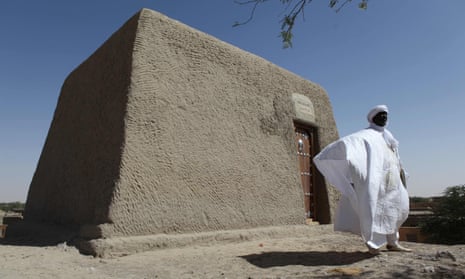
Desert city in Mali formally receives keys to shrines to Muslim saints after they were rebuilt with Unesco funding following damage in 2012
Sane Chirfi, who represents the family which looks after the mausoleum of Alpha Moya, in front of the mausoleum. Photograph: Sebastien Rieussec/AFP/Getty Images
Timbuktu has celebrated the recovery of its historic mausoleums, destroyed during an Islamist takeover of northern Mali in 2012 and rebuilt thanks to the UN cultural agency, Unesco.
The desert city formally received the keys to the shrines to Muslim saints at a ceremony on Thursday in theDjingareyber mosque. Five head of cattle were ritually sacrificed just after dawn before a reading of the entire Qur’an and the handing of the keys to the families in charge of the shrines’ care.
Al-Qaida-linked insurgents wrecked 14 of the city’s earthen shrines, which were built during Timbuktu’s 15th- and 16th-century golden age as an economic, intellectual and spiritual centre.
Unesco representative Lazare Eloundou told the officials, diplomats and religious and traditional dignitaries attending the ceremony: “This day celebrates the remarkable and courageous work accomplished to recover your dignity.”
Islamist fighters destroyed the centuries-old shrines after seizing the city in April 2012, when they implemented a version of Islamic law that forced women to wear veils, with whipping and stoning as punishment for transgressions.
On Sunday, a Danish woman, Anja Ringgren Loven, a Philanthropist an founder of African Children’s Aid Education and Development Foundation ( ACAEDF) who lives with her partner and son in Uyo rescued a little boy who had been abandoned by his family because they claimed he was a ‘witch’. She took him into her care, fed him, gave him clothes and he is currently receiving some medical attention. This was what she shared on her Facebook page:
‘Ive seen much here in Nigeria over the last 3 years. I have spared you for many experiences when we’ve been on the rescue operations. Thousands of children are being accused of being witches and we’ve both seen torture of children, dead children and frightened children. This footage shows why I fight. Why I sold everything I own. Why I’m moving out in uncharted territory. Why the new documentary is so important for dinnødhjælps work so we can shout world leaders up so we can get focused on superstition in Nigeria! I hope you will all see with when ” Anja Africa ‘ is being shown on TV. Together we can make the biggest difference! I have chosen to call the boy hope for right now, we all hope that he survives. He is in the hospital and you guys want to support hope with medicine and hospital bills as you daily pay for hospitalisation here in Nigeria can make a contribution on dinnødhjælps mobilepay: 27 21 24 34 The details of today’s rescue mission yesterday I can’t go into now. But you will see it all in the new documentary “Anja Africa” being shown on dr2 so remember to watch!
Today she gave an update of the boy she named”Hope” :
“We should be proud to be Danes. We are a loving people and we’re taking good care of each other. We are always together when there is need our help. When natural disasters hit, famine ravaging and civil wars devastate affects us deeply. We Danes are among the world’s most generous. We are the best to donate money to charity, help others and do volunteer work. More than every other of us Danes gives money to charity and help people we don’t know. And we must be proud!
Right now we danes hung out in the foreign media. Incorrect or not, media account certainly not the true picture of US DANES. For when it comes to love there are no countries can match us! So let us give the media something new to write about. Something to really show them who we danes are! Just 2 DAYS HAVE DINNØDHJÆLP RECEIVED 1 million dollars to help little hope!!! Let me repeat that: 1 million Danish kroner is donated to dinnødhjælp in just 2 DAYS!!! My feelings are sitting without his clothes! I’m so overwhelmed! I’m so grateful and touched by all the love, care and huge support there just pouring here to Nigeria all the way from Denmark! I want as long as I live thank you all every day! I forget simply never! With all the money we can besides giving hope the very best treatment now also build a doctor clinic on the new land and save many more children out of torture! It’s just so great! The building must be called hope clinic – donated city Denmark!! They say thanks is just a poor words, but for me means thank you life! And to those who says otherwise, then we can today together prove to the whole world that charity indeed still exists in Denmark!heart emoticon Hope’s condition is stable now. He’s taking food for himself, and he responds to the medicine he gets. Today he has had powers to sit up and smiling at us. He’s a strong little boy. To see him sit and play with my own son is without doubt the greatest experience of my life! I just don’t know how to describe it in words. This is what makes life so beautiful and valuable and therefore I will let the pictures speak for themselves: Today we “groundbreaking” ceremony at the construction site. Ground breaking ceremony where we are so lucky to the Danish Ambassador here in Nigeria participates as a guest of honour and the keynote speaker. I can’t believe our ambassador and his sweet wife comes entirely from the capital Abuja to our little village where dinnødhjælp builds a new orphanage and participating in our ceremony. It’s so big and I am very pleased to see the ambassador again. Today during the ceremony I will think of our architect Martin from engineers without borders and his working group as in more than half a year now worked every day for putting together and draw dinnødhjælps orphanage in cooperation with our Nigerian engineers. I very much look forward to show you all the outcome when the construction is finished. About 1 years running little hope around on dinnødhjælps new orphanage and play with all the other children. Where there is love, there is life